Importing timber, furniture, or wooden handicrafts from Indonesia offers access to world-class craftsmanship and rich forest resources like Teak, Mahogany, and Mindi. However, navigating international legality standards can be complex.
To ensure your container passes through customs without delays, fines, or seizure, this guide provides a step-by-step legal and operational checklist for international buyers, backed by official regulations and direct verification portals.
Part 1: Key Legal Frameworks You Must Know
Before initiating any trade, understand the dual legal protection system:
1. Indonesian Export Legal Framework
- SVLK (Sistem Verifikasi Legalitas dan Kelestarian): Indonesia’s national Timber Legality Assurance System regulated under Permen LHK No. 8 Year 2021. Every manufacturer/exporter must hold a valid SVLK certificate to export wood legally.
- V-Legal Document: An export license issued through the Indonesian Ministry of Environment and Forestry’s SILK platform (Sistem Informasi Legalitas dan Kelestarian) verifying that timber originates from 100% legal sources.
- FLEGT License (EU & UK Special Provision): Under the bilateral Voluntary Partnership Agreement (VPA), Indonesia is the only country in the world whose V-Legal documents are officially recognized as FLEGT Licenses by the European Union and the United Kingdom (under the UK-Indonesia VPA).
Official References & Legal Citations:
- Indonesian SVLK Regulation: Ministry of Environment and Forestry Regulation Permen LHK No. 8/2021
- SILK Verification Portal (KLHK): Official SILK Indonesia Portal
- Indonesia National Single Window (INSW Customs Portal): INSW Official Website
2. Destination Country Regulations & Compliance Standards
- European Union: EU Deforestation Regulation (EUDR – Regulation (EU) 2023/1115) & FLEGT VPA. Timber with an Indonesian FLEGT License automatically satisfies the legality criteria under EU regulations. Importers must also retain plot-level geolocation details to confirm deforestation-free origins post-December 31, 2020.
- United Kingdom: UK Timber Regulation (UKTR) & UK FLEGT VPA. Indonesian V-Legal certificates continue to be accepted as FLEGT Licenses for direct UK customs entry.
- United States: The Lacey Act (16 U.S.C. §§ 3371–3378). Prohibits trading illegally sourced plants and timber; requires an electronic declaration of species and harvest location via PPQ Form 505.
- Australia: Illegal Logging Prohibition Act 2012 (ILPA) and 2012 Regulations. Importers must conduct due diligence unless importing certified SVLK/V-Legal timber.
- Japan: Clean Wood Act (2017 / Revised 2023). Encourages businesses to use legally harvested wood verified by recognized national systems like SVLK.
Official References & Regulatory Citations:
- EU FLEGT VPA & EUDR Information: European Commission Timber & Deforestation Policy
- EU FLEGT VPA Agreement with Indonesia: EU FLEGT Facility – Indonesia VPA Overview
- US Lacey Act Requirements (USDA APHIS): USDA APHIS Lacey Act Official Declaration Page
- Australia Illegal Logging Laws (DAFF): Australian Department of Agriculture, Fisheries and Forestry
- Japan Clean Wood Act (Forestry Agency): Forestry Agency of Japan – Clean Wood Act Info
Part 2: Step-by-Step Buyer Sourcing & Import Checklist
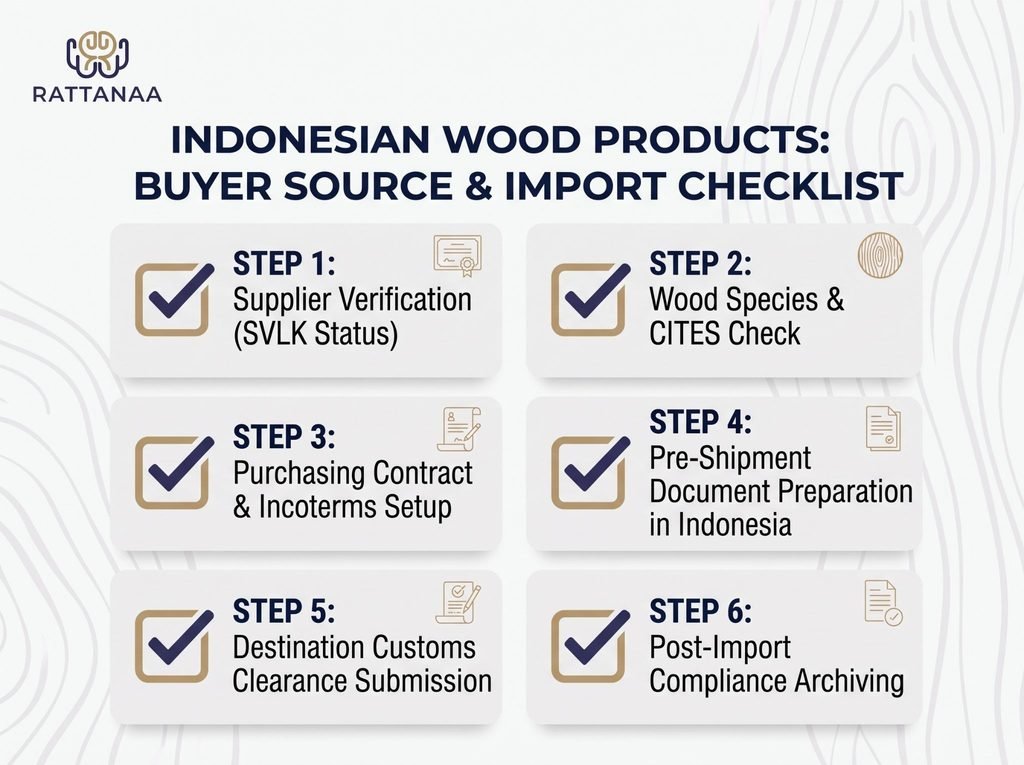
Step 1: Verify Supplier SVLK Certification
Never place a deposit before verifying the factory’s legal standing in Indonesia.
- Action Item: Request the supplier’s SVLK Certificate Number and PBPHH / ETPIK (Eksportir Terdaftar Produk Industri Kehutanan) registration.
- Verification Method: Check the supplier’s credentials directly on the official Indonesian Ministry portal.
- Red Flag: If a supplier claims they can “borrow” another company’s SVLK license for export, do not proceed. The exporter of record on the Bill of Lading must match the SVLK certificate holder.
Official Verification Tool:
- Database Check: Search registered SVLK companies on the SILK Public Database Portal
Step 2: Check Wood Species & CITES Regulations
Ensure the wood species used in your product is allowed for export and does not violate protected flora lists.
- Allowed Commercial Species: Teak (Tectona grandis), Mahogany (Swietenia macrophylla), Mindi (Melia azedarach), Suar (Albizia saman), Rubberwood (Hevea brasiliensis).
- CITES Appendix II Alert:
- Sonokeling / Rosewood (Dalbergia latifolia): Requires a specialized CITES Export Permit alongside SVLK.
- Action Item: Require your manufacturer to specify scientific species names on the Proforma Invoice (PI).
Official References & Legal Citations:
- CITES Species Search & Appendices: Official CITES Secretariat Checklist
- Indonesian Forest Species Classification: Ministry of Environment and Forestry
Step 3: Draft Safe Purchase Orders (PO) & Incoterms
Protect your financial investment with strict contractual legal clauses.
- Recommended Incoterms: FOB (Free on Board) or CIF (Cost, Insurance, and Freight). Under FOB/CIF, the Indonesian supplier is legally responsible for clearing Indonesian export customs and issuing the V-Legal/FLEGT document.
- Mandatory Contract Clause:“Final payment is contingent upon the supplier providing a valid, verified V-Legal Document / FLEGT License matching the exact container packing list and Bill of Lading.”
Official Reference:
- International Trade Terms Standard: International Chamber of Commerce (ICC) Incoterms 2020
Step 4: Ensure Complete Pre-Shipment Document Package
Prior to vessel departure from Indonesian ports (e.g., Tanjung Emas Semarang, Tanjung Perak Surabaya, or Tanjung Priok Jakarta), confirm your supplier has secured these 6 Essential Export Documents:
| Document Name | Issued By | Purpose for Buyer |
| V-Legal / FLEGT License | LVLK / Ministry of Environment & Forestry (KLHK) | Proves 100% legal origin; clears customs in destination port. |
| Pemberitahuan Ekspor Barang (PEB) | Indonesian Customs (Bea Cukai) | Official export declaration. |
| Bill of Lading (B/L) | Shipping Line | Proof of shipment and title of goods. |
| Commercial Invoice & Packing List | Exporter / Supplier | Cargo content specification and valuation. |
| Certificate of Origin (Form E, Form A-2, etc.) | Ministry of Trade | Reduces or waives import duties under Free Trade Agreements (FTA). |
| Phytosanitary / Fumigation Certificate | Indonesian Quarantine Authority / Approved Fumigator | Proof that wooden products/packaging are free from pests (ISPM 15 compliance). |
Official References & Legal Citations:
- ISPM 15 Phytosanitary Standards: International Plant Protection Convention (IPPC) ISPM 15 Guidelines
- Indonesian Customs (Bea Cukai) Export Rules: Directorate General of Customs and Excise Indonesia
Step 5: Destination Customs Clearance Procedures
Follow region-specific import protocols upon cargo arrival:
For European Union & UK Importers:
- Obtain the FLEGT License issued by Indonesia’s SILK system.
- Register the FLEGT License in the EU TRACES NT system (or UK FLEGIT portal) prior to customs declaration.
- Enjoy expedited clearance: Customs officials skip mandatory due diligence for legality because Indonesian FLEGT-licensed timber is legally pre-approved.
EU Customs Submission System: TRACES NT System Log-in & Verification
For US Importers:
- Request scientific names (Genus and Species) from your Indonesian supplier.
- Complete USDA APHIS PPQ Form 505 (Plant and Plant Product Declaration) under the Lacey Act via Automated Commercial Environment (ACE).
- Attach the Indonesian V-Legal Document as supporting evidence of legal sourcing.
US Customs Filing System: U.S. Customs and Border Protection (CBP) ACE Portal
For Australian Importers:
- Conduct your Due Diligence System (DDS) check as per ILPA 2012.
- Archive the Indonesian V-Legal Document into your compliance dossier; it serves as a low-risk classification indicator for Australian Department of Agriculture, Fisheries and Forestry (DAFF).
Australian Compliance Portal: DAFF Due Diligence Guidelines
For Japanese Importers:
- Submit the V-Legal Document to show compliance under the Clean Wood Act.
- Register as a Type 1 or Type 2 Wood-related Business Entity if required.
Japan Registration Portal: Clean Wood National Verification System
Step 6: Post-Import Audit Trail Archiving
International timber regulations require importers to maintain complete documentation trails.
- Retention Period: Keep all shipment records (V-Legal/FLEGT License, B/L, Invoice, CITES permits, and Customs Declarations) for at least 5 years.
- Audit Readiness: In the event of an audit by your local forestry or customs department, having the V-Legal document attached to your PO guarantees hassle-free verification.
Summary Matrix: Quick Compliance Checklist
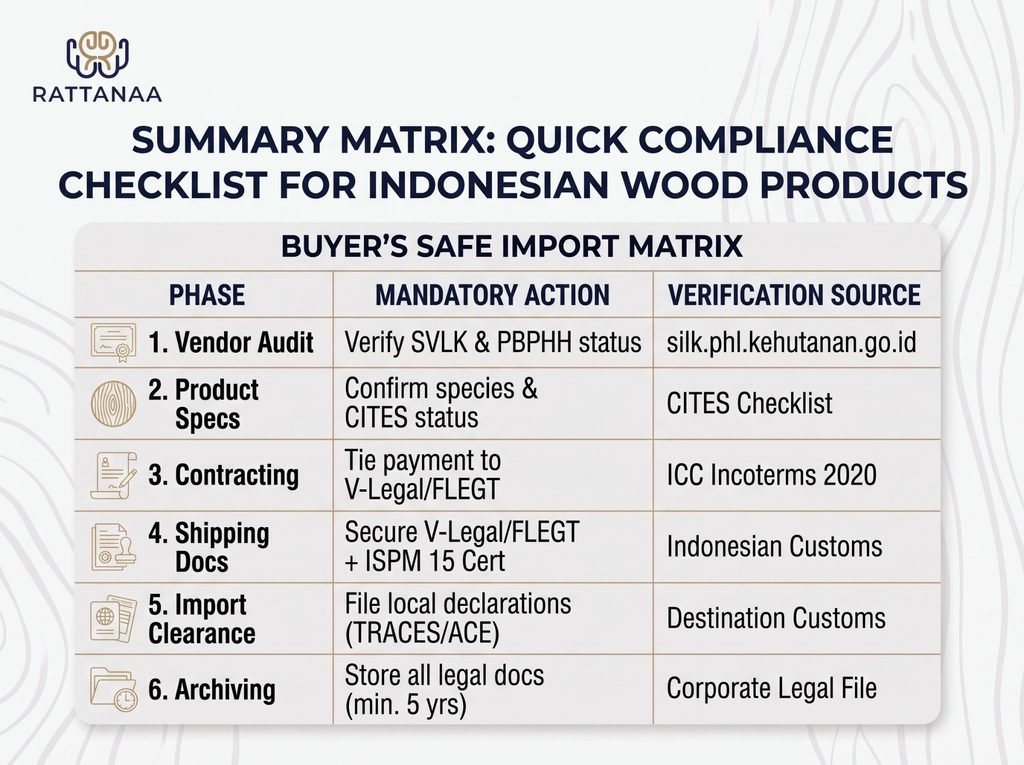
By following this standardized procedure, your procurement process from Indonesia will be 100% compliant, secure, and immune to customs penalties or shipment seizures. As part of our commitment to regulatory compliance and environmental sustainability, Rattanaa has met all legality requirements and holds official SVLK certification. For more information regarding our profile and products, you can visit the Rattanaa.